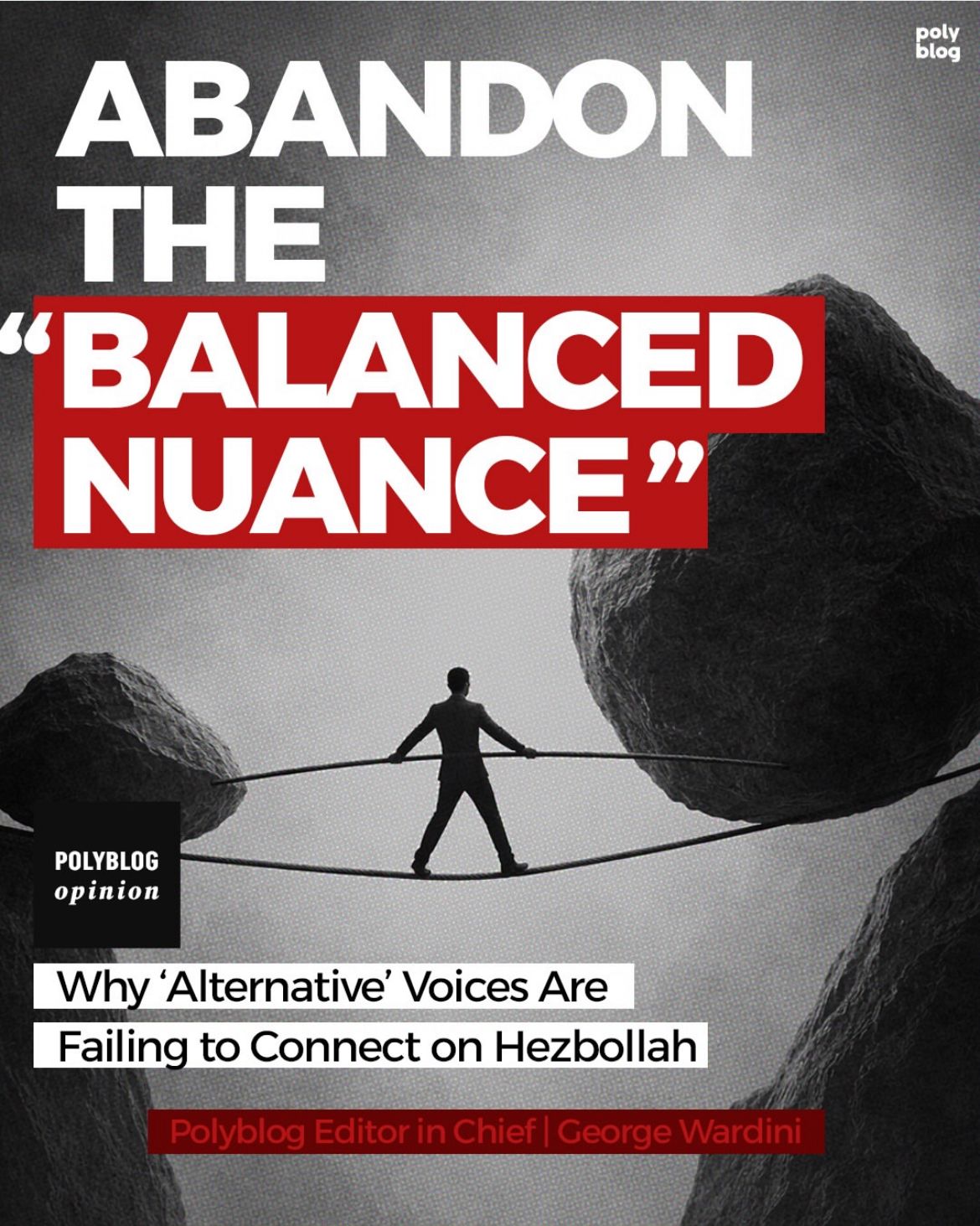

Abandon the “Balanced Nuance”: Why “Alternative” voices are failing to connect on Hezbollah

06/04/2026
A
A GROWING DISCONNECT
There’s a growing gap in Lebanon between what people are experiencing and how ‘alternative’ or ‘intellectual’ voices in the online media ecosystem are choosing to explain it.
It’s not a tone problem. It’s not that lebanese people suddenly reject moderation or balance. It’s that the alternative framing being pushed doesn’t match reality, and the disconnect begins with a wrong diagnosis and concludes with false equivleence.
THE REFLEX TO BALANCE EVERYTHING
Alternative voices have a reflex. Everything must be balanced. Every statement must come with a counterweight. Every problem must have “two sides.” And there’s always a “third way.”
So Hezbollah’s actions get paired with reactions to them. Placed in the same frame, treated as comparable. It feels fair. It sounds responsible. But it flattens the situation. Because not everything operates on equal terms.
WHO IS BEING ASKED TO RESTRAIN THEMSELVES?
You see it clearly in moments of tension. Calls for calm. Appeals to responsibility. Warnings about civil war.
All valid in principle, until you look at where the pressure lands. It rarely lands on the actor that controls escalation. Hezbollah decides how far things go. It holds the weapons and sets the ceiling. Yet the calls for restraint are mostly directed elsewhere. That pattern doesn’t go unnoticed.
WHERE RESPONSIBILITY GETS REASSIGNED
At that point, the framing starts doing something else. It places an organized actor and a set of scattered reactions on the same level.
It shifts the conversation toward managing responses instead of examining what produced them. Over time, responsibility gets diluted. Not removed, just spread thin enough that it loses meaning.
A MISREADING OF THE CRISIS
Part of the problem is how Hezbollah’s role itself is understood. Lebanon is often described as a country with multiple, competing problems: sectarian tension, corruption, state failure within which Hezbollah is framed as “one of many” chronic challenges.
But the truth is, Hezbollah has outgrown all other problems, even the ones that precede it, to the point that it has become their active sponsor and center of gravity.
ALL ROADS LEAD TO HEZBOLLAH
Polarization doesn’t just appear. It’s activated by a sectarian group that applies excessive force and violence to control major national decisions against the will of all other communities. Corruption doesn’t just survive. It’s protected by a group that assigns middle management to corrupt allies who keep Hezbollah’s grip on security and foreign policy unchallenged. State weakness isn’t just a governance failure. It’s a required condition maintained by a group that can only thrive in a failed state, so it ensures a state never rises. Treat them separately, and you end up chasing symptoms in circles.
THE MIDDLE GROUND THAT DOESN’T EXIST.
In such an asymmetrical dynamic, the “middle ground” becomes an impossible position to hold.
A functioning state and a structure that overrides it do not meet halfway. Trying to stand in between often produces vague positions that sound measured, but ultimately say very little. And audiences can tell.
PREVENTING CIVIL WAR?
If the aim of balanced centrism is to prevent social unrest and keep strong emotions under control, it often achieves the opposite.
By flattening responsibility and softening clear realities, it alienates the very audience it seeks to address; those who are directly affected, who already understand the imbalance, and who are looking for clarity, not dilution.
When people feel that their lived reality is being blurred or equated with the source of their crisis, frustration doesn’t disappear. It builds. And it finds other, less controlled outlets. In trying to contain tension, this approach ends up amplifying it.
WHY IT’S NOT CONNECTING
This is where the disconnect comes from. It’s not that people are rejecting balance. They’re rejecting explanations that don’t line up with what they’re seeing. When the framing feels off, the message doesn’t land. And when it doesn’t land, it gets ignored.
THERE IS AN ALTERNATIVE.
The path to restoring social cohesion is not paved through manipulation of perceptions and reality.
Cohesion comes from clarity; by naming the source of rupture, not obscuring it.
In Lebanon’s case, the burden of responsibility rests on Hezbollah as the only organized group that initiates and controls the dynamics of social rupture. A message that reflects this reality does not inflame tensions-it grounds them. It replaces confusion with direction, and ambiguity with accountability.