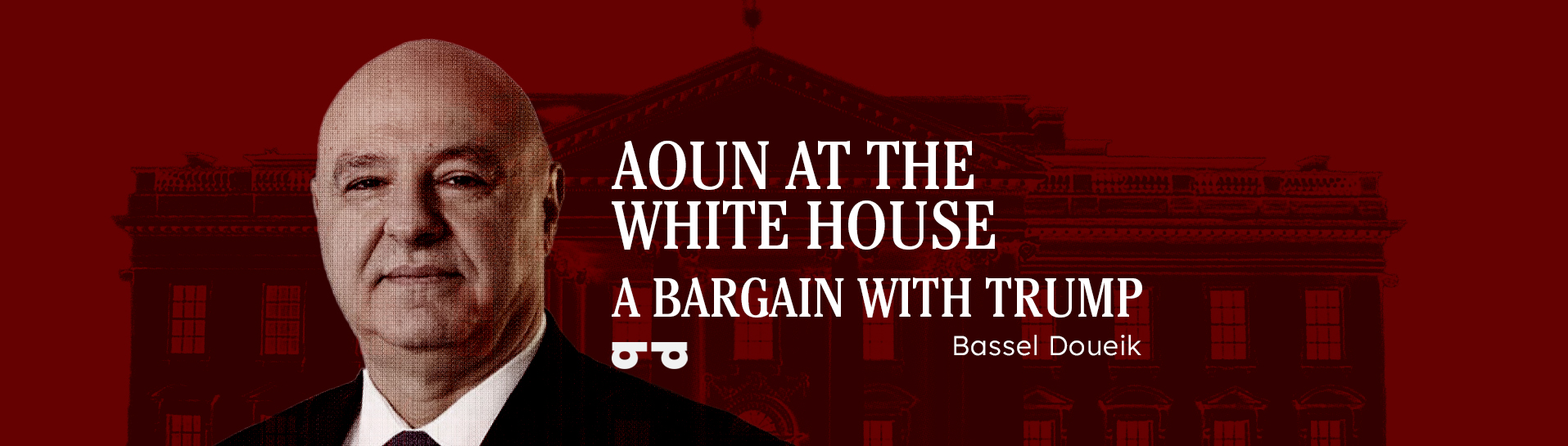

Aoun at the White House: A Bargain with Trump

22/07/2026
A
Lebanese President Joseph Aoun is set to meet US President Donald Trump at the White House today. The meeting comes amid the launch of the first pilot zones in southern Lebanon, as announced by the US Embassy in Beirut. As of Tuesday, Lebanese soldiers and vehicles entered the village of Zawtar el Gharbiyeh. This deployment represents the first practical test of the American-brokered agreement.
Why is it important?
Aoun arrives at the White House as the first Lebanese president to do so in two decades. The meeting takes place amid a renewed US–Iran confrontation and a weakened but still armed Hezbollah, with ongoing Israeli occupation of at least 650 km2 of Lebanese territory.
The significance of this meeting is that it revives direct diplomacy between Beirut and Washington, amid the latter’s longstanding investments in the Lebanese Armed Forces. The summit itself could be an important turning point from conflict management toward a political settlement between Lebanon and Israel.
What Does Aoun Want From Trump?
Aoun comes to the table presenting the following Lebanese demands:
• A binding timetable for complete Israeli withdrawal.
• An end to Israeli strikes and other activities including property destruction.
• Financial and logistical support for the Lebanese Army for complete deployment.
• US guarantees that the launched pilot zones will not become permanent buffer zones.
• Recognition that Hezbollah’s disarmament must proceed in parallel with Israeli withdrawal through the gradual expansion of the pilot-zone model.
The bottom line being: Aoun is asking Washington to convert Israeli withdrawal into restored sovereignty. The long-term effects of such actions will only aid the LAF in restoring arms monopoly and strengthening state institutions.
What Will Trump Ask of Aoun?
The other half of the bargain includes Washington’s following demands:
• A binding timetable for Hezbollah’s disarmament.
• The LAF’s deployment and acquisition of Hezbollah infrastructure south of the Litani River.
• Progress toward a final peace agreement with Israel.
• An initial agreement that could help Trump win politically.
• Strengthening ties with the Ahmad al Sharaa administration.
With this, we keep in mind that Washington’s final position is not Israeli withdrawal but turning the withdrawal as leverage for a final peace deal with Israel. This aligns with the Trump administration’s doctrine of “Peace through Strength.”
The Wild Cards
While Trump and Aoun are the parties negotiating, they are not the parties engaged in fighting. Iran, through Hezbollah, is naturally inclined to spoil any track that threatens to undercut its influence in Lebanon. Israel’s far right, who are openly dissatisfied with what they see as security concessions in withdrawing from Lebanon, are also in a position to exploit future violence in order to push Netanyahu toward a more hardline position.
The LAF
The LAF remains as the main center of gravity. Lebanon cannot assert agency without a strong and willing army. Enabling Lebanon’s armed forces would not only need financial and logistical support, but political cover to 1) operate in areas occupied by Israel and 2) circumvent domestic risks paused by an uncooperative Hezbollah.
Finally, Aoun must not hinge Lebanon’s future on promises of withdrawal. He must return from Washington with a binding mechanism that expands state authority under every Israeli withdrawal so that no power vacuum is left behind to be filled by Hezbollah.