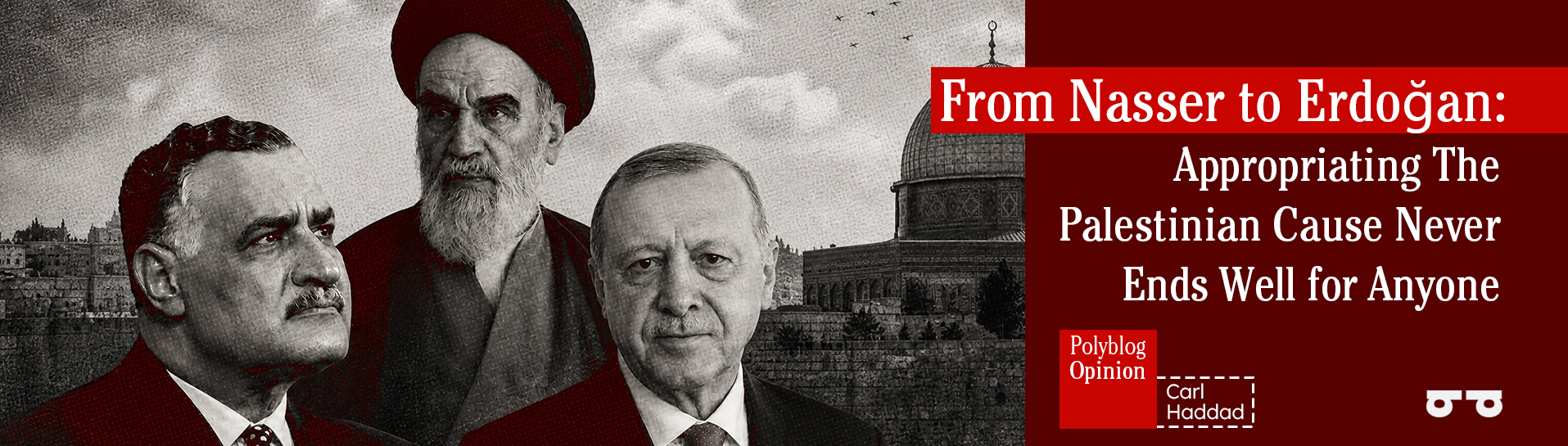

From Nasser to Erdoğan: Appropriating The Palestinian Cause Never Ends Well for Anyone

18/08/2026
A
Gamal Abdel Nasser was perhaps the clearest Arab example of an aspiring regional leader laying claim to the Palestinian cause as a vehicle for power. By placing Palestine at the centre of his vision for Arab nationalism, Nasser established himself as the voice of the Arab world. His influence and impact devastated many Arab states, but especially for Lebanon, the consequences of the Palestinian armed presence were immense. Apart from Nasser’s incessive meddling in Lebanon’s domestic politics and the destabilizing effects they brought, the 1969 Cairo Agreement Lebanon was strong-armed into accepting under Nasser’s Egypt institutionalised the presence and military activity of the Palestine Liberation Organization in Lebanon and eventually led to the erosion of state authority and the subsequent war that erupted in 1975.
The same logic later appeared in revolutionary Iran.
Following the peace-agreement between Israel and Egypt in 1978, Khomeini made Palestine a central pillar of Iran’s regional narrative. It was a useful tool to antagonize his Sunni rivals in Mecca and outbid them for the leadership of the Muslim World. Behind the rhetoric of resistance was a broader project of exporting the Islamic Revolution (ideologically) and building an arc of influence across the Middle East through security. Tehran developed powerful networks and armed allies in Iraq, Syria, Lebanon and Yemen, with Hezbollah becoming the most prominent example in Lebanon. Palestine became not only a cause, but a language through which Iran projected power far beyond its borders.
Now comes Erdoğan.
The Hamas-led attack on Israel that began on October 7, 2023, reshaped the regional balance. Turkey now finds itself face-to-face with a strategic reality that offers it opportunity to compete with Israel over influence in the Levantine sphere.
That makes Erdoğan’s increasingly vocal embrace of Gaza, Syria and Lebanon more alarming, and, potentially consequential. With Saudi position on Israel having eased and Iran losing its access to Palestine; Turkey is the sole regional power that is able to fill that gap. Appropriating the Palestinian cause could give Ankara moral legitimacy among Arab and Muslim publics; audiences in which Turkey has no alternative cultural influence. Syria gives it strategic depth; Lebanon gives it another arena in which to assert relevance and challenge Israeli foreign policy –all territories within a continuous geographic land bridge to the Levant.
From Nasser to Khomeini and now Erdoğan, the pattern is familiar: the Palestinian cause becomes a passport to Lebanon, Syria and the wider region –and it never ends well for anyone involved.