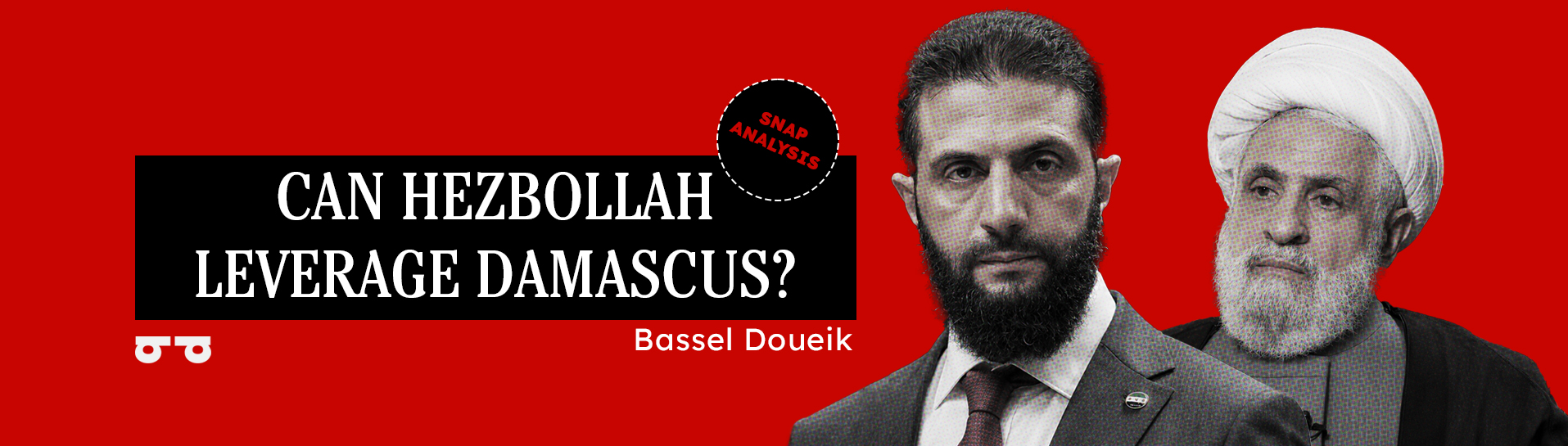

Hezbollah to leverage Damascus?

07/08/2026
A
On Tuesday, Hezbollah Chief Naaim Qassem stated that he had no objection meeting openly with Syria’s new leadership, a first since the ouster of former President Bashar al Assad. Under mounting military, domestic and regional pressure, Hezbollah needs an understanding with Damascus to prevent a hostile eastern front; something US President Donald Trump suggested last month. The official Syrian stance remains that it will not intervene militarily in Lebanon. But, statements may not assure a crumbling Hezbollah cut off and isolated from its Shiite sphere of influence.
The Syrian government has far greater room for maneuver in this case than Hezbollah does. Syrian President Ahmad al Sharaa has gained tremendous Arab, American and European backing since the ouster of the former regime and US suggestions that he could confront Hezbollah only add to the maneuverability. In contrast, Hezbollah faces four strategic realities at once. Militarily, the group has suffered major leadership, infrastructure and operational losses.
It is isolated from its parent organization, the IRGC, and under constant military pressure from the IDF, where the latter maintains military superiority and considerable freedom of action over Lebanon. Another reality is that Damascus is no longer its logistical intermediary, making it harder for the group to smuggle in weapons and military-grade equipment.
In addition, Tehran’s ability to project power has been significantly restricted. Finally, the group can no longer assume that “resistance” produces unlimited domestic legitimacy. This is because the Lebanese government has withdrawn the group’s legitimacy through its historic announcements of declaring the group as an outlaw organization and its attempts to restrict arms to state security services.
Therefore, Hezbollah needs Damascus more than Damascus needs Hezbollah. How this asymmetry will play out remains to be seen, but Syria will remain the main actor.