
Lebanon in the middle of an Israeli-Turkish strategic competition

17/08/2026
A
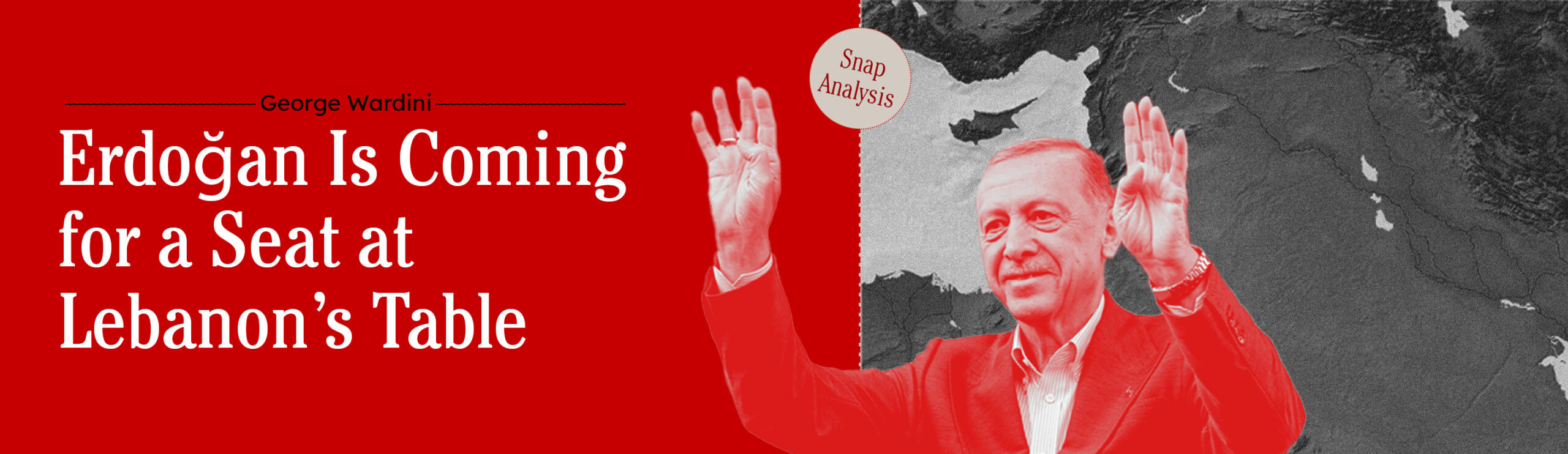
Turkish President Recep Tayyip Erdoğan delivered unusually direct remarks on Lebanon during an interview with Al Jazeera, revealing that he had personally raised the Lebanese file with U.S. President Donald Trump.
“Israel is the aggressor against Lebanon, and we must save it from the attacks. Washington’s support is important to pull it out of the line of fire,” Erdoğan said.
He described the continued Israeli attacks on Lebanon as a source of “great concern” for Ankara and said he had discussed with Trump “the necessity of stopping the war on Lebanon.”
Erdoğan also linked Lebanon to Gaza, where Turkey has taken an increasingly active diplomatic role.
“Turkey cannot leave Gaza alone,” he said, adding that “Hamas is sincerely fulfilling its commitments, while Israel continues the war.”
But Erdoğan’s remarks may reflect something larger than Turkish solidarity with Lebanon and Gaza.
Turkey Is Expanding Its Strategic Perimeter
Ankara is increasingly presenting itself not merely as an observer of the conflicts surrounding Israel, but as a regional power entitled to participate in shaping their political and security outcomes.
Turkey is already deeply involved in the Gaza file. It has sought a greater role in Syria, proposed participating in security arrangements that could succeed UNIFIL in Lebanon, and expanded its defense coordination with major regional powers.
Against this backdrop, Erdoğan’s decision to discuss Lebanon directly with Washington—while publicly challenging Israel’s conduct in both Lebanon and Gaza—may signal an effort to extend Turkey’s strategic influence further across the Levant.
The old Middle Eastern competition was often understood primarily through the prism of Iran versus Israel and the Gulf states, with Turkey playing a more irregular role.
The emerging picture is more complicated.
Turkey is increasingly seeking to expand its political and security role across Syria, Lebanon and Palestine, while deepening relationships with Gulf powers and presenting itself as a counterweight to an increasingly assertive Israel.
On July 30, standing beside President Joseph Aoun, Erdoğan announced that Turkey wanted to participate in whatever security mechanism succeeds UNIFIL, pledged continued assistance to the Lebanese Army and reaffirmed Ankara’s support for Lebanese sovereignty.
If that ambition materializes, it would move Turkey beyond political commentary and toward an attempted institutional security role inside the Lebanese file.
Erdoğan has also begun explicitly linking Lebanese security to Turkish national security. In June, he said Israeli attacks on Lebanon and Syria had reached a point where they threatened Turkey itself, telling Turkish lawmakers that Ankara’s security was tied to the security of both countries.
That kind of language increasingly places parts of the Levant within Turkey’s conception of its own strategic perimeter.
Turkey and Israel Are Competing Over the Regional Order
Turkey and Israel increasingly appear to view the same geographic belt—Syria, Lebanon, Gaza, the Eastern Mediterranean and, to some extent, the Red Sea—through competing strategic lenses.
The Turkish-Israeli rivalry is becoming a structural feature of several major regional files, with Syria currently representing its clearest arena.
Ankara’s emerging worldview appears to be that:
Israel cannot be allowed to emerge from the region’s wars as the uncontested military power capable of determining the security architecture of neighboring Arab states.
That helps explain why Erdoğan’s rhetoric on Lebanon is becoming more assertive.
If Israel says, in effect, we will determine the conditions under which we leave Lebanese territory, Erdoğan’s counter-position increasingly appears to be: Lebanon’s security architecture cannot be determined by Israel alone, and Turkey intends to have a say.
This interpretation also fits Turkey’s broader push for what Turkish officials describe as “regional ownership”: the idea that regional powers should assume greater responsibility for their own security architecture rather than allowing Washington—or Israel—to determine the regional order alone.
Turkey has simultaneously pursued deeper security relationships with Saudi Arabia and Pakistan, while exploring broader regional coordination that could eventually include other major Arab states. Lebanon therefore matters within a much larger competition.
It is not simply another country Erdoğan is defending rhetorically. It lies along a strategic arc in which Ankara is increasingly attempting to establish itself as one of the powers capable of influencing what comes after years of regional war.
Gaza Is Further Along. In Lebanon, Turkey Is Still Trying to Enter the Room.
There is, however, an important distinction between Turkey’s position in Gaza and its position in Lebanon.
In Gaza, Turkey already possesses meaningful leverage. It has longstanding relations with Hamas, has been directly involved alongside Qatar, Egypt and the United States in diplomatic negotiations, and has become part of the political machinery surrounding attempts to implement a post-war arrangement.
In Lebanon, Turkey is still trying to enter the room. Ankara does not currently possess anything comparable to Iran’s historic influence through Hezbollah, Saudi Arabia’s longstanding political networks, France’s institutional relationship with Lebanon, or Washington’s influence over the Lebanese Army and negotiations with Israel.
That is precisely why Turkey’s proposed role in a post-UNIFIL security mechanism would be significant. It could provide Ankara with a new institutional foothold inside the Lebanese security architecture—one it has not traditionally possessed.
Erdoğan is therefore not yet speaking for Lebanon. But he is increasingly behaving as though Turkey should be one of the regional powers entitled to have a say in what comes next for Lebanon.
For Beirut, fears of a coming “Turkish hegemony” would be overstated—at least for now. But a Turkish bid to expand its sphere of influence to include Lebanon? Absolutely.