
The Mecca Pact is not Muslim Nato

13/08/2026
A
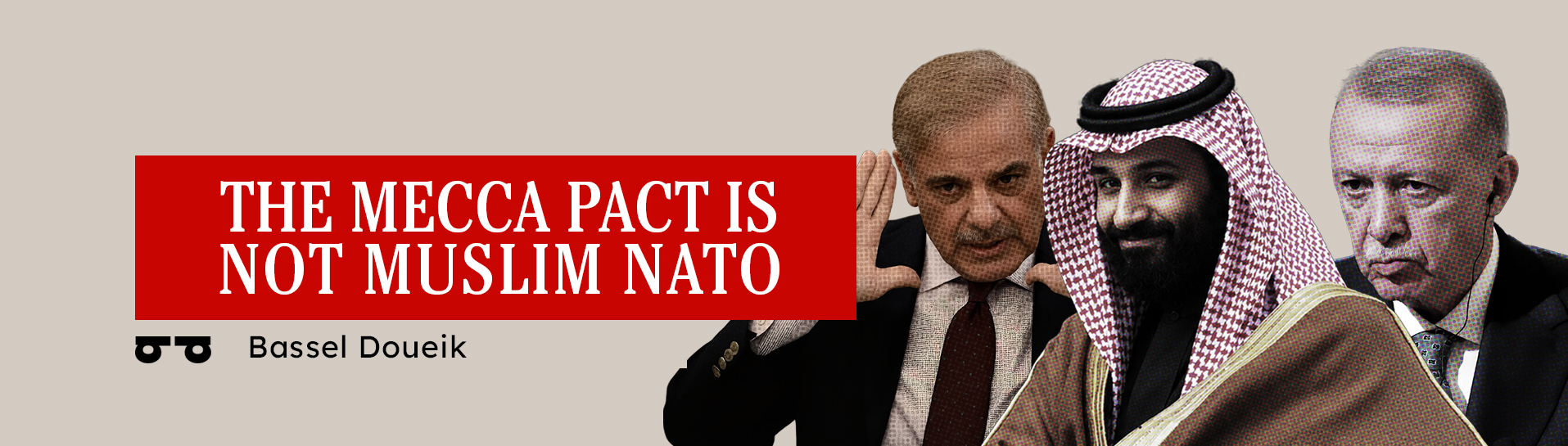
On August 7th, Turkish President Recep Tayyip Erdogan and Pakistani Prime Minister Shehbaz Sharif flew to the Islamic holy city of Mecca to sign one of the most misinterpreted agreements of the Middle East. Saudi Arabia, Turkiye, and Pakistan officially inaugurated a joint defense agreement that has been in the making for several years, according to Turkish Foreign Minister Hakan Fidan.
The agreement is neither a fully developed “Muslim NATO” nor a walk away from Washington. Its primary attempt is to build an autonomous regional deterrence framework. Its implementation will be determined by the three members’ willingness to adhere to the framework’s main clauses, especially the collective defense.
An attack on one is an attack an all
The central provision of the Mecca Agreement is joint defense. It resembles the North Atlantic Treaty Organization’s Article 5 which treats an attack on one member as an attack on all. The agreement comes against the backdrop of the US-Iran War, Israel’s occupation of Syrian, Lebanese, and Palestinian territory, the IRGC’s attacks against Gulf States, and shortcomings over U.S. protection of its allies in the region. Unlike NATO, the Mecca Agreement does not yet possess the North Atlantic organization’s integrated command, joint planning, or collective military drills, making it depend on individualized political and military commitments.
Why did the pact emerge now?
The Middle East’s security architecture has changed dramatically since Hamas’s attack against Israel on October 7, 2023 and the unfolding events leading up to the ongoing US-Iran war. In light of these threats, regional states are adapting to the forming security architecture with active deterrence against two hostile actors in the region: Iran and Israel. First, the IRGC and its proxies missile and drone attacks presented the vulnerability of Gulf States, energy infrastructure and international shipping through the Straits of Hormuz and Bab al Mandeb. Second, Israel’s occupation of territory in Syria, Lebanon, and Gaza, its attack on Hamas’s headquarters in Doha, Qatar, and its destabilizing effects of security in the region lead to such a hostile stance from the three members of the pact.
On the other hand, confidence in Washington has deteriorated. Gulf governments doubt when and under what conditions Washington will use its military might to protect its allies in the region. Another reason would also be Saudi Arabia’s failed attempt of reaching a joint defense pact with the U.S.
Objectives of the Pact
Saudi Arabia: security for economic transformation
- Riyadh supplies money, political weight, territory, and an expanding defense market. Its immediate term objective is to protect its energy infrastructure and projects affiliated with the MBS Vision 2030. The pact adds Turkish and Pakistani military and defense capabilities to the existing American security partnership.
Turkiye: strategic access and industrial expansion
- Ankara maintains a capable and growing defense industry, NATO experience, and a large military. With the pact, Ankara asserts a foothold in Gulf security. The arrangement also creates investment opportunities for Turkish drones, missiles, naval systems and electronic warfare technology.
Pakistan: military for geopolitical footprint
- Islamabad contributes a large and experienced military. The country gains renewed geopolitical importance through the pact. Pakistan’s nuclear status adds deterrent ambiguity, but there is not yet evidence that the pact creates a Saudi or Turkish nuclear umbrella.
Regional Consequences
For the United States
All three members of the pact have very good relations with the current US administration. The pact itself falls within the American security umbrella in the Middle East. It could provide useful burden-sharing in military, maritime, and defense sectors. Washington will likely remain the major security partner but may lose being the region’s exclusive strategic organiser.
For Israel
The agreement introduces a counterweight to Israeli military power in the region. The pact is likely to further complicate normalization between Riyadh and Tel Aviv. Israel could see this as a Sunni alliance against its regional aspirations. It has already labeled Turkiye as the ‘New Iran’ and it does not have diplomatic relations with Pakistan.
For Lebanon
The pact’s immediate consequences are likely to be indirect for the country. Lebanon is not covered by its collective-defence provision, and no announced mechanism connects the agreement to the Lebanese Armed Forces or Hezbollah’s disarmament. Its relevance would increase if Saudi Arabia and Türkiye used the framework to coordinate military assistance, reconstruction funding or diplomatic support for the Lebanese state. Until then, claims that it could replace Hezbollah’s deterrence remain speculative.