
Stop blaming “both sides”… There is only one.

01/04/2026
A
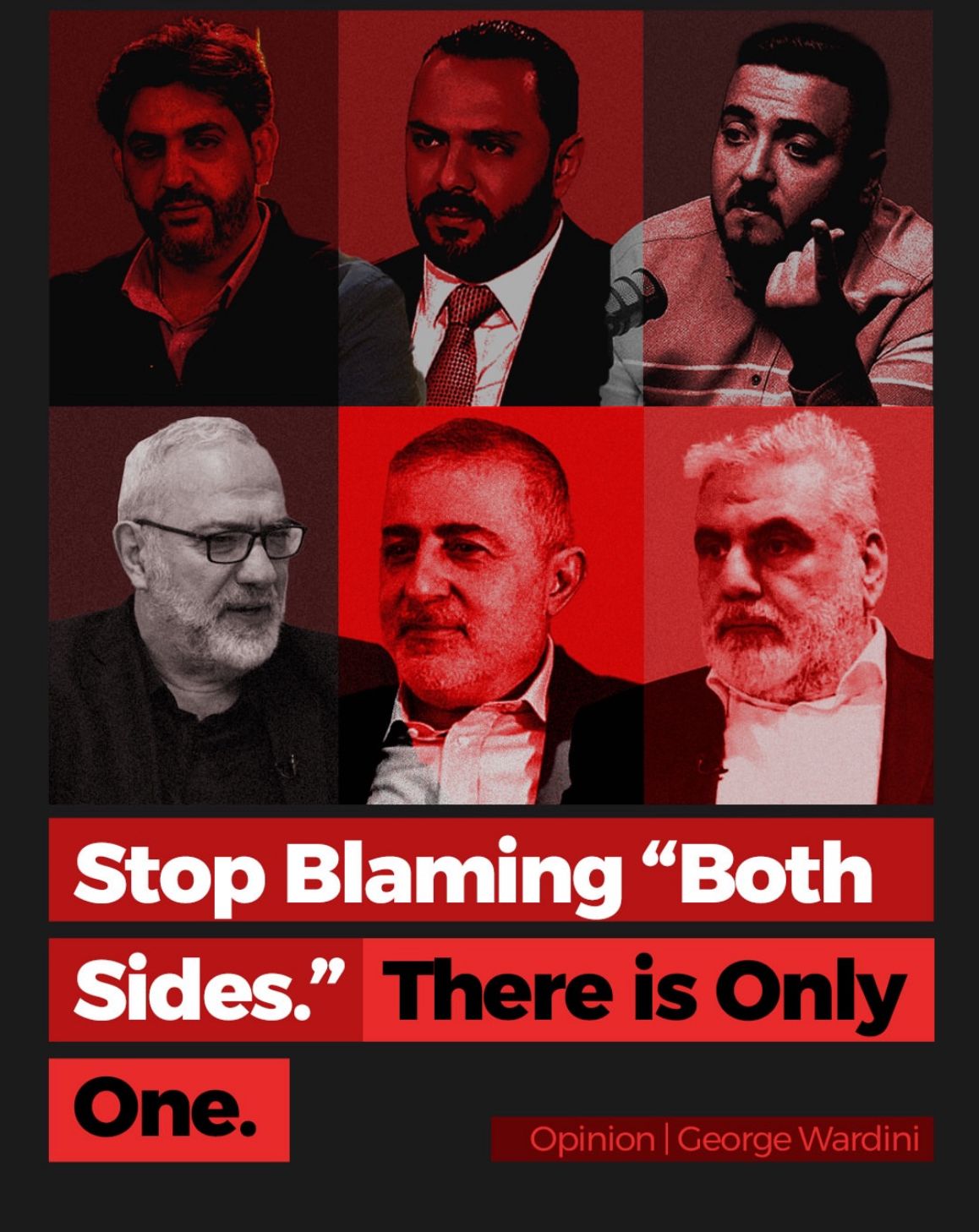
Stop Blaming “Both Sides.” There is Only One.
There is an increasingly widespread notion of equivalence in Lebanon when we perceive a threat to our social cohesion. This often tends to blame problematic elements “on both sides” for the harm, in an attempt to mitigate or counter it.
This sentiment is well intentioned and, at first sight, somewhat reassuring.
Despite everything pulling us apart, Lebanese still make an effort to preserve the integrity of their social fabric in times of war.
But the hard truth is, there are no “two sides.” There is only one. The rest of us are reacting.
It’s easier to pretend otherwise. Acting on the premise of equivalence makes it easier to point at the problem without dealing with the responsibility of choosing where you stand, but you’d only be scratching the surface.
The damage this approach does is that it falsely distributes blame and ignores causality. It treats symptoms rather than addressing the problem itself.
Instead of preventing societal collapse, we end up silencing the warning signs.
Yes, it is entirely valid to say that certain voices that oppose Hezbollah can do more harm than good to our message.
We have called it out in the past, and we will continue to do so.
But the disproportionality is difficult to ignore.
Hezbollah’s media ecosystem routinely relies on intimidation and threats of violence as an organized, intentional tactic. It is not incidental. It is structured, sustained, and deliberate. And it is often backed up by action.
Whereas incidents of extreme reactions to that language are neither organized nor deliberate. Nor are they nearly as frequent or mainstream.
Labeling those reactions simplistically as
“sectarian hate speech” is short-sighted and forgetful of the past 20 years. But more importantly, it does two harmful things in the long term.
First, it makes it harder to rebuild social cohesion in the post-war period, because it assumes that our society is inherently divided along sectarian or regional lines.
This is false. Lebanon is split over value systems and worldviews.
One driven by the natural pursuit of self-interest and the other enforced through unnatural coercion and militarization.
And this divide transcends sect and religion, even if it predominantly affects one community more than the others.
Rebuilding unity around shared values is far more achievable, because the majority of Lebanese across sects
already align on core issues such as Hezbollah’s weapons and Lebanon’s role in the region. Look at the most recent findings by Callup, published last December, as evidence.
When we mischaracterize an entire segment of society as sectarian or
intolerant, we are taking a convenient shortcut that intentionally ignores, or misunderstands, the triggers created by an abnormal course of events imposed by Hezbollah.
Second, it relieves those who initiate and sustain these dynamics of most of their responsibility. In this case,
Hezbollah and its circles. It creates a false equivalence between those who instigate and those who react, between organized political actors and ordinary citizens or vocal political opponents.
This may seem like a difficult position to accept, but in reality, it simplifies the problem.
Assigning responsibility
where it belongs makes it easier to control the damage and reverse it.
The simple truth is that there is only one group in Lebanon that openly threatens and exercises political violence, that weaponizes paralysis as a form of coercion, that bends the will of a nation and denies it the right to
self-determination. There is only one group that can start wars, negotiate their terms, and normalize intimidation as political practice. That group is Hezbollah.
The rest are reacting in predictable ways to an imposed reality. Focusing on the outcome instead of the source may be easier, but it comes at the cost of political clarity.