
France, the Return of Faith?

30/09/2026
A
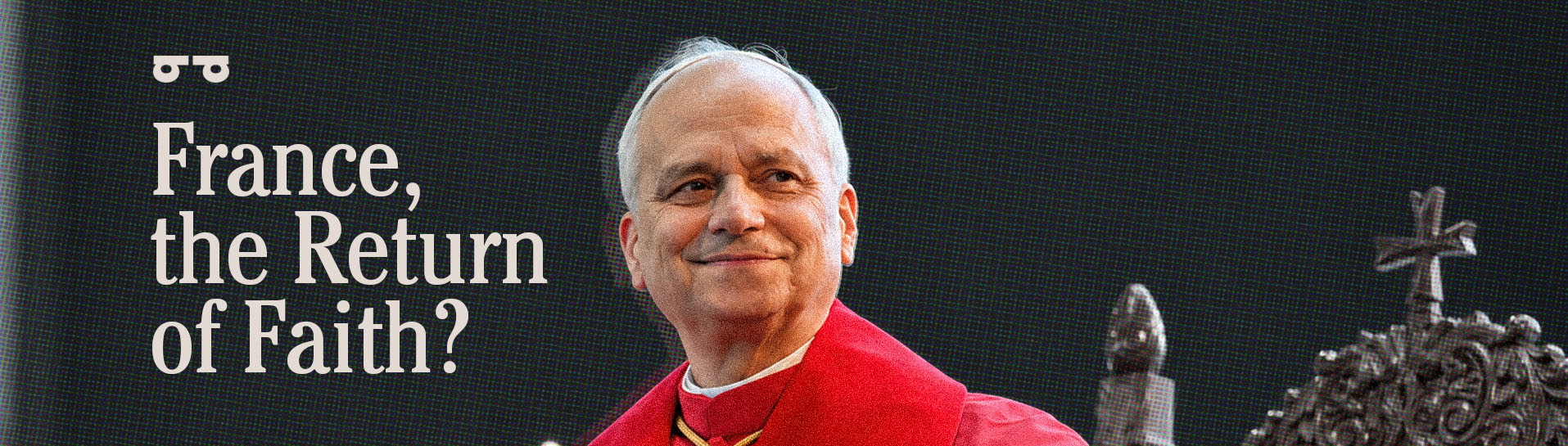
Pope Leo XIV’s visit to France has offered more than striking images of crowds, cathedrals and celebrations. It has highlighted something happening beneath the surface of one of Europe’s most secular societies: a renewed curiosity about faith.
In 2026, more than 21000 perons were baptized into the Catholic Church in France, including 13000 adults. Adult baptisms have more than tripled in a decade, with 18 to 25 year-olds now the largest adult age group.
This does not mean that France is suddenly becoming a religious country again. Secularization remains deeply rooted. But something is changing.
For decades, France moved progressively away from organized religion. Yet the disappearance of religious practice did not necessarily eliminate the human need for meaning.
Today, people all around the world are living through another profound transformation. Technology and artificial intelligence are reshaping daily life, answering questions, creating content and increasingly influencing how we work and communicate. And perhaps precisely because technology is becoming so powerful, people are asking older questions again: Who am I? What gives life meaning? Where do I belong?
And they are searching for answers in many places. Some are turning toward ancient cultures and traditions, exploring India, indigenous practices in the Amazon and elsewhere, meditation, rituals and forms of spirituality that predate modern society by thousands of years. Others are rediscovering established religions that have survived across centuries, including Christianity.
The paths are different, but the underlying search may be similar: meaning, identity, belonging and something larger than ourselves.
The return to Christianity can therefore be understood, in part, as a search for an anchor. It may also carry an identity dimension. For some, rediscovering Christianity is about reconnecting with a cultural and historical identity at a time when fears of identity dilution are increasingly present in public debate. It can also be read as a reaction against what some consider an exaggerated form of secularism, or against a persistent sense of guilt surrounding France’s colonial past.
This is not extremism. Nor does rediscovering Christianity necessarily mean returning to the France of the past.
France has long been known as the “eldest daughter of the Church.” Its cathedrals, saints and centuries of Christian culture remain deeply embedded in its history.
And the timing is remarkable. With France heading toward its next presidential election in 2027, Pope Leo’s visit comes at a politically sensitive moment. During his meeting with Emmanuel Macron, the Pope spoke directly on issues including bioethics and artificial intelligence, urging society not to “lose our humanity.”
Will this renewed visibility of Christianity and identity play any role in shaping France’s future? It is too early to say.
But after decades of declining belief, spirituality appears to be gaining space again. Christianity will inevitably have its share of that search, and perhaps France could become an unexpected place for a new beginning.