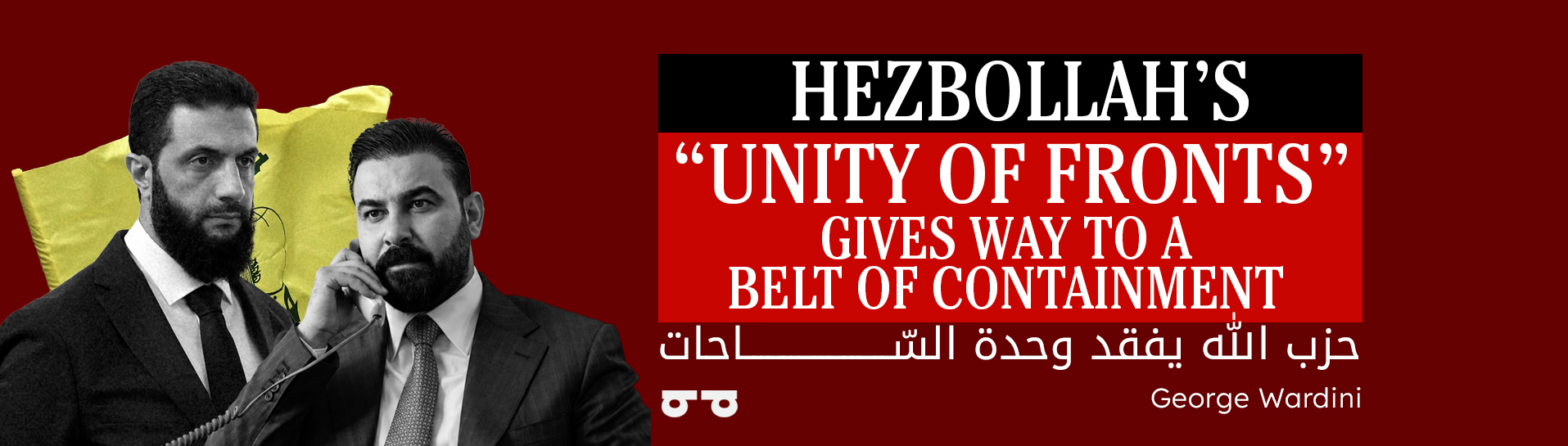

Hezbollah’s “Unity of Fronts” Gives Way to a Belt of Containment

27/07/2026
A
Hezbollah has never been forced to operate in an antagonistic regional environment quite like the one confronting it today.
For most of its existence, the party was not an isolated Lebanese organisation attempting to survive within hostile surroundings. It functioned as a central component of a transnational military architecture extending from Tehran through Baghdad and Damascus to Beirut, with allied fronts reaching Gaza and Sana’a.
This network provided Hezbollah with far more than political allies or ideological solidarity. It secured the movement of weapons, money, personnel and military expertise across borders. In the muddy waters of substate operations, this kind of logistics is everything –and no strategy could have survived without it.
It provided Iran with strategic depth, deterrence and the ability to project power throughout the region without relying exclusively on conventional Iranian forces.
The so-called “unity of fronts” was therefore never merely a slogan. It was the political expression of a physical infrastructure: penetrated states, permissive borders, parallel armed organisations and uninterrupted logistical corridors.
But that infrastructure is now coming apart.
The same geography that once protected Hezbollah and connected it to Iran is increasingly being transformed into a belt of containment around it.
Iraq: From Iranian Strategic Depth to Open Defiance
For Iran, Iraq has always carried profound strategic significance.
The eight-year Iran–Iraq War of the 1980s entrenched Iraq in the Iranian security imagination as both a potential threat and an indispensable strategic buffer. When Saddam Hussein’s regime was overthrown by the United States in 2003, Tehran moved swiftly to exploit the political vacuum created by American blunders.
The collapse of the Iraqi state, the fragmentation of its institutions and the subsequent rise of Sunni insurgent movements created opportunities for Iran to entrench itself across Iraq’s emerging political and security order. Tehran cultivated political parties, financed armed factions and developed relationships that allowed it to exercise outsized influence over Iraqi decision-making.
Iraq consequently evolved from Iran’s most dangerous regional adversary into one of its most valuable arenas of strategic depth.
Two decades later, however, Baghdad is beginning to push back.
The government of Prime Minister Ali al-Zaidi has pledged to restore the state’s monopoly over arms and disarm factions operating outside official authority. Al-Zaidi’s government has also committed itself to preventing Iraqi territory from being used by armed groups to threaten neighbouring states.
This does not mean that Iranian influence in Iraq has disappeared. Iran-aligned factions remain deeply embedded (and diffused by design, making them harder to trace) within the country’s security, political and economic structures. Nor is it certain that the Iraqi government possesses the institutional strength required to dismantle them.
But the political direction is nevertheless significant.
A government in Baghdad publicly committing itself to dissolving armed structures linked to Tehran represents a level of defiance Iran would scarcely have expected from a country it had come to regard as a secure component of its regional architecture.
The consequences extend directly to Lebanon.
On 15 July, Iraq’s Ministry of Finance reportedly circulated instructions directing banks, public institutions and affiliated state bodies to implement recent American sanctions against individuals and companies linked to Hezbollah’s financial network. The measure did not amount to the creation of an independent Iraqi sanctions regime, but it indicated Baghdad’s willingness to enforce restrictions targeting Hezbollah-linked entities.
Subsequent reports indicated that the directive may have been withdrawn or rescinded. Yet even if its implementation proves temporary, the episode remains politically consequential. It demonstrates that Hezbollah’s financial and commercial presence in Iraq can no longer rely on automatic political protection.
Iraq, once an open terrain for Iranian power projection, is gradually becoming a contested arena in which that influence must be defended rather than simply exercised.
Syria: The Severing of the Corridor
In Syria, formerly Iran’s only state state ally, the reversal is even more consequential.
Under Bashar al-Assad, Syrian territory constituted the indispensable bridge connecting Hezbollah to Iran through Iraq. Weapons, missiles, military equipment and personnel could travel across the Iranian–Iraqi–Syrian corridor before reaching Lebanon.
Syria was not simply another ally within the axis. It was the geographical hinge holding the network together.
Following Assad’s fall, Hezbollah Secretary-General Naim Qassem publicly acknowledged that the party had lost its military supply route through Syrian territory.
The new Syrian authorities have since adopted a fundamentally different posture.
On 16 July, Syrian officials announced that they had intercepted a shipment of advanced weapons crossing from Iraq and allegedly destined for Hezbollah. According to the Syrian account, long-range missiles, rockets and drones had been concealed inside an oil tanker travelling towards Baniyas. Hezbollah denied involvement and rejected the Syrian allegations.
Regardless of the competing accounts surrounding that particular shipment, the broader transformation is unmistakable.
Under Assad, the Syrian state enabled Hezbollah’s military supply lines. Under the new authorities, it is actively attempting to identify and obstruct them. Damascus is no longer operating as a bridge between Iran and Lebanon. It is becoming a barrier between them.
This is not merely the loss of a political ally. It is the loss of the territorial infrastructure through which Iranian support could be translated into Hezbollah’s military power.
From Regional Encirclement to Strategic Isolation
Taken together, the developments in Iraq and Syria represent more than two isolated setbacks.
Iraq is beginning to constrict Hezbollah’s political, financial and organisational space. Syria is disrupting the logistical infrastructure that once connected the party directly to Iran.
Elsewhere, the remaining fronts face their own pressures.
Hamas has been militarily devastated, deprived of much of its former governing structure and placed under persistent Israeli pressure, even though it retains personnel and some operational capacity inside Gaza.
The Houthis, meanwhile, remain capable of launching missiles and threatening maritime routes, but face repeated military pressure from Israel and Western powers and have once again entered direct confrontation with Saudi Arabia. Recent Houthi attacks on Saudi infrastructure and shipping have been followed by renewed Saudi strikes in Yemen, illustrating that the Yemeni front remains active but increasingly exposed.
Iran’s regional network has therefore not disappeared, nor have all its constituent organisations been neutralised. But the network no longer enjoys the territorial continuity, political protection or freedom of movement that once made it so formidable.
The “unity of fronts” was built on the assumption that borders could be rendered politically irrelevant: weapons could move across them, allied factions could coordinate through them and weakened states could be prevented from exercising meaningful sovereignty over them.
That assumption is now being reversed.
What remains to be seen is whether Hezbollah can adapt its operational strategy to this new environment—or whether the “unity of fronts” will ultimately be remembered as the doctrine that reached its greatest territorial extent immediately before the region began closing in around it.