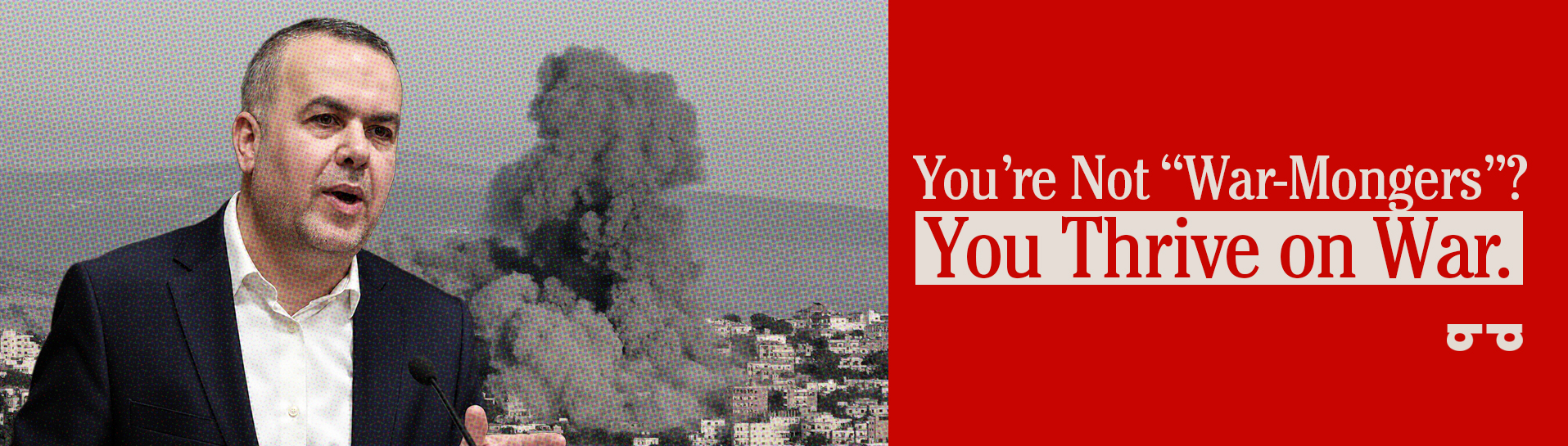

You’re Not “War-Mongers”? You Thrive on War!

28/09/2026
A
Hezbollah MP Hassan Fadlallah, a member of the Loyalty to the Resistance bloc, has once again insisted that his party is “not fond of wars,” arguing: “We are not war-mongers. These wars were imposed on us because our fate, particularly that of the people of the South, is to live next to this Zionist entity, where our people have experienced a history marked by attacks, ambitions, and attempts to seize our villages and towns.”
Hezbollah may reject the label of being “war-mongers,” but the record tells a different story. In virtually every instance, the decision to open a front or enter a war was taken by the party, while the Lebanese state was left to deal with the consequences and fallout.
If Hezbollah is “not fond of wars,” how does one explain Lebanon being drawn into four wars since 2000—wars in which the decision to become involved was taken outside the Lebanese state’s institutions?
Since Israel’s withdrawal from southern Lebanon in 2000, and as Hezbollah consolidated its military and political influence at the expense of the Lebanese state’s authority, Lebanon has been drawn into four wars without an independent state decision to enter them and without the matter being referred to its constitutional institutions. This is not to mention the repeated internal confrontations and the recurring threats to civil peace.
In the 2006 July War, Hezbollah captured two Israeli soldiers, triggering a 33-day war that inflicted heavy human, material and economic losses on Lebanon.
In 2013, Hezbollah decided to intervene militarily in the Syrian war on the side of Bashar al-Assad’s regime. Lebanon’s official institutions had no role in the decision to enter that war, yet the country was left to absorb its wide-ranging security, political and economic consequences—from terrorist attacks and internal tensions to massive waves of Syrian displacement.
In 2023, following the October 7 attack known as “Operation Al-Aqsa Flood,” Hezbollah opened a front from southern Lebanon under the banner of “supporting Gaza,” once again without seeking the approval of the Lebanese state. For months, the southern border became an active battlefield, with Lebanon paying a heavy human, material and security price for the decision.
Then, on March 2, 2026, Hezbollah once again decided to draw Lebanon into a new war—this time under the banner of “supporting Iran.”
There is another point that cannot be overlooked: Hezbollah itself was built around an ideology that places the “liberation of Jerusalem” at its core. So, according to that doctrine, how exactly is Jerusalem supposed to be liberated without war and military confrontation? By scattering rice and flowers and celebrating with ululations?
The issue, therefore, goes beyond Hezbollah’s insistence that it is “not fond of wars.” War is not an incidental feature of the ideology on which the party was built; it is part of its political and military project.
And that raises a legitimate question: if the logic of war and military confrontation were to disappear, what would remain of the rationale Hezbollah gives for maintaining an armed role outside the authority of the Lebanese state?