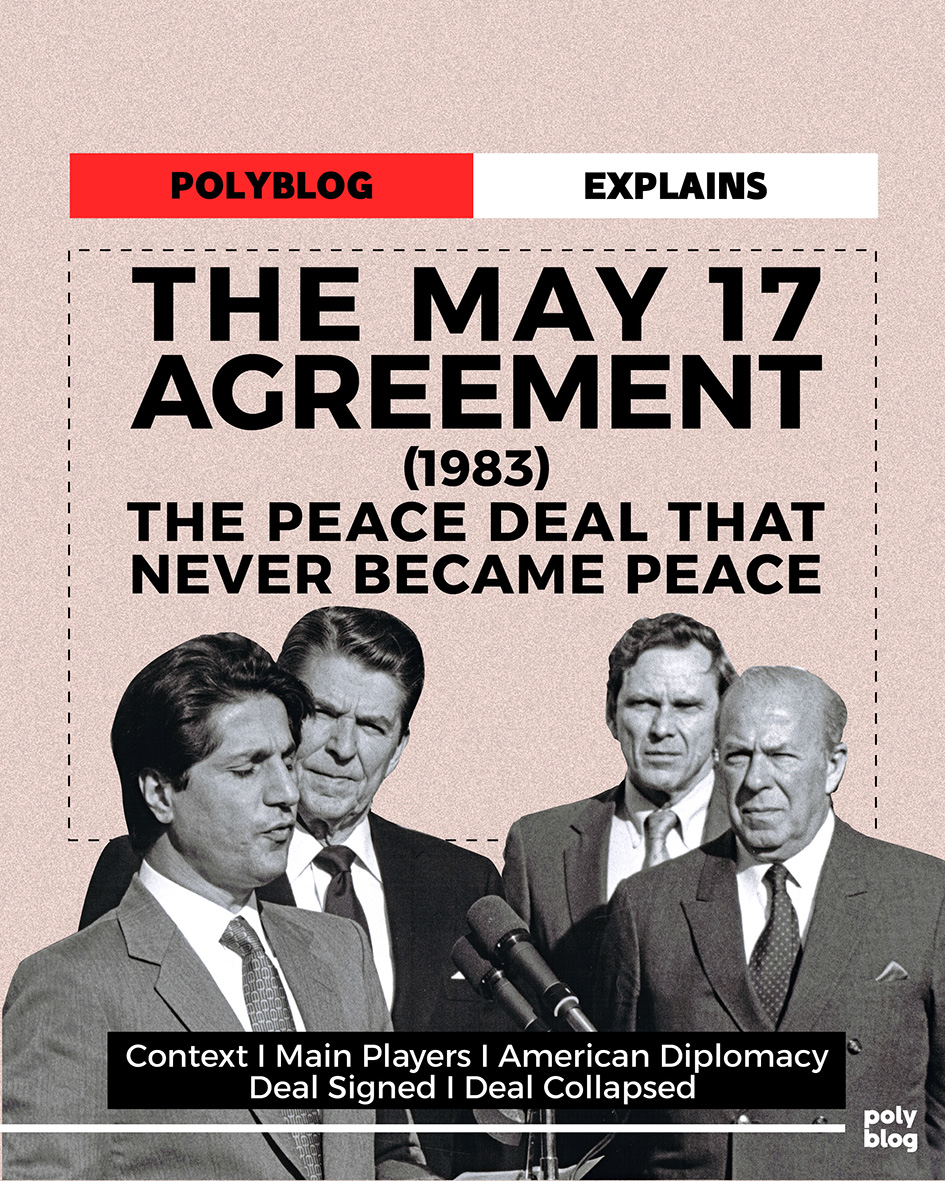

The May 17 Agreement (1983) | The peace deal that never became peace

21/05/2026
A
The Context: Lebanon Under Occupation and Collapse
Israel invaded Lebanon in June 1982 under the stated goal of expelling the PLO after years of cross-border attacks. But the invasion quickly expanded far beyond southern Lebanon, reaching Beirut itself. The deeper objective became political: Political and security realignment of Lebanon while weakening both Syria and Palestinian armed influence.
At the same time, Syria already maintained tens of thousands of troops in Lebanon and viewed the country as part of its strategic sphere of influence. Washington entered the scene through the Reagan administration, hoping to engineer a broader regional order favorable to American and Israeli interests during the Cold War.
The Main Players — And What Each Wanted
Lebanon (Amine Gemayel)
Amine Gemayel’s government wanted to restore Lebanese sovereignty and secure the withdrawal of Syrian and Israeli forces. But Lebanon had little leverage: the state was weak, divided, and dependent on U.S. backing. Gemayel believed American mediation could help recover territory and rebuild the state.
Israel
Israel wanted security guarantees preventing armed groups from operating near its northern border. It also sought political normalization with Lebanon and hoped to pull Beirut away from Syrian influence. Its leverage came through military occupation and the bombardment campaign that expelled the PLO from Beirut to Tunisia.
Syria
Syria viewed the agreement as a strategic threat. Damascus feared a separate Lebanese-Israeli deal would isolate Syria and weaken its dominance over Lebanon. Its leverage came from its presence in Lebanon and support for militias hostile to Israel.
The United States
The Reagan administration viewed Lebanon through a Cold War lens. Washington wanted to stabilize Lebanon, secure Israeli withdrawal, reduce Syrian influence, and build momentum toward a broader Arab-Israeli peace process after Camp David.
What Was the May 17 Agreement?
Signed on May 17, 1983, by Lebanon and Israel under American mediation, the agreement formally declared that the state of war between Lebanon and Israel had ended. It outlined a framework for Israeli withdrawal in exchange for security arrangements in southern Lebanon.
But the agreement’s writing stopped short of becoming a full peace treaty. The core issue, however, was hidden in the details.
Israel conditioned its withdrawal on the simultaneous withdrawal of Syrian troops from Lebanon, which it viewed as a security threat. But Syria had never agreed to that condition and rejected the agreement entirely. In practice, this gave Damascus the ability to block implementation from day one.
American Diplomacy’s Core Miscalculation
The Reagan administration believed Lebanon could become the next major Arab-Israeli diplomatic breakthrough after Camp David.
But American diplomacy toward Lebanon suffered from a fatal flaw: it attempted to finalize a Lebanese-Israeli agreement before securing Syrian buy-in.
Washington largely sidelined Hafez al-Assad from the negotiating process, assuming that once the agreement was finalized, Saudi Arabia and other Arab actors could pressure Damascus into eventually accepting it. That assumption proved catastrophically wrong.
The Americans overestimated Saudi leverage over Assad, underestimated Syria’s strategic investment in Lebanon, and misunderstood Assad himself.
For Assad, Lebanon was not a secondary file. It was central to Syrian regional influence, bargaining power, and national security doctrine.
From Assad’s perspective, the May 17 Agreement threatened to transform Lebanon from a Syrian sphere of influence into an American-Israeli aligned state on Syria’s border.
And because Syrian withdrawal was tied to Israeli withdrawal in the agreement itself, Assad effectively gained veto power over the entire deal.
The agreement was signed without Syria, but it could never survive against Syria.
Iran, Hezbollah, and the Rise of Suicide Warfare
After Israel’s 1982 invasion, Iran’s Revolutionary Guard deployed to Lebanon’s Beqaa Valley with Syrian facilitation to build an ideologically loyal armed movement inspired by Iran’s Islamic Revolution. That movement would eventually become Hezbollah, with figures like Imad Mughniyeh rising quickly within its militant networks.
These groups introduced large-scale suicide bombings targeting Western military presence. In 1983, the U.S. Embassy in Beirut was bombed, followed months later by the attacks on the U.S. Marine barracks and French paratrooper headquarters, killing hundreds of servicemen.
The attacks severely weakened the May 17 Agreement. American and French public support for involvement in Lebanon collapsed, multinational forces gradually withdrew, and the credibility of U.S. guarantees to Lebanon deteriorated.
At the same time, Hezbollah and Iranian-aligned groups framed the agreement as normalization imposed under Israeli occupation and American protection. By 1984, the political and security environment sustaining the agreement had effectively collapsed.
Why the Agreement Failed
The May 17 Agreement failed because it tried to produce peace on paper before resolving the actual balance of power on the ground.
Syria refused to withdraw its troops or recognize the agreement, effectively blocking implementation.
Large segments of Lebanon’s Muslim political forces rejected the agreement outright, viewing it as forced normalization under Israeli occupation rather than a sovereign national compromise.
American diplomacy overestimated the Lebanese state’s capacity and underestimated the extent to which regional actors, especially Syria and Iran, controlled the Lebanese file.
Israel’s security conditions made the agreement politically toxic inside Lebanon.
At the same time, the rise of Hezbollah, Iranian revolutionary influence, and the wave of suicide attacks against Western interests destabilized the environment necessary for implementation.
By early 1984, Lebanon was descending deeper into conflict, the Lebanese Army was fracturing, and the multinational forces were withdrawing.
Under mounting pressure by domestic political allies of Assad, Amine Gemayel officially canceled the agreement in March 1984.