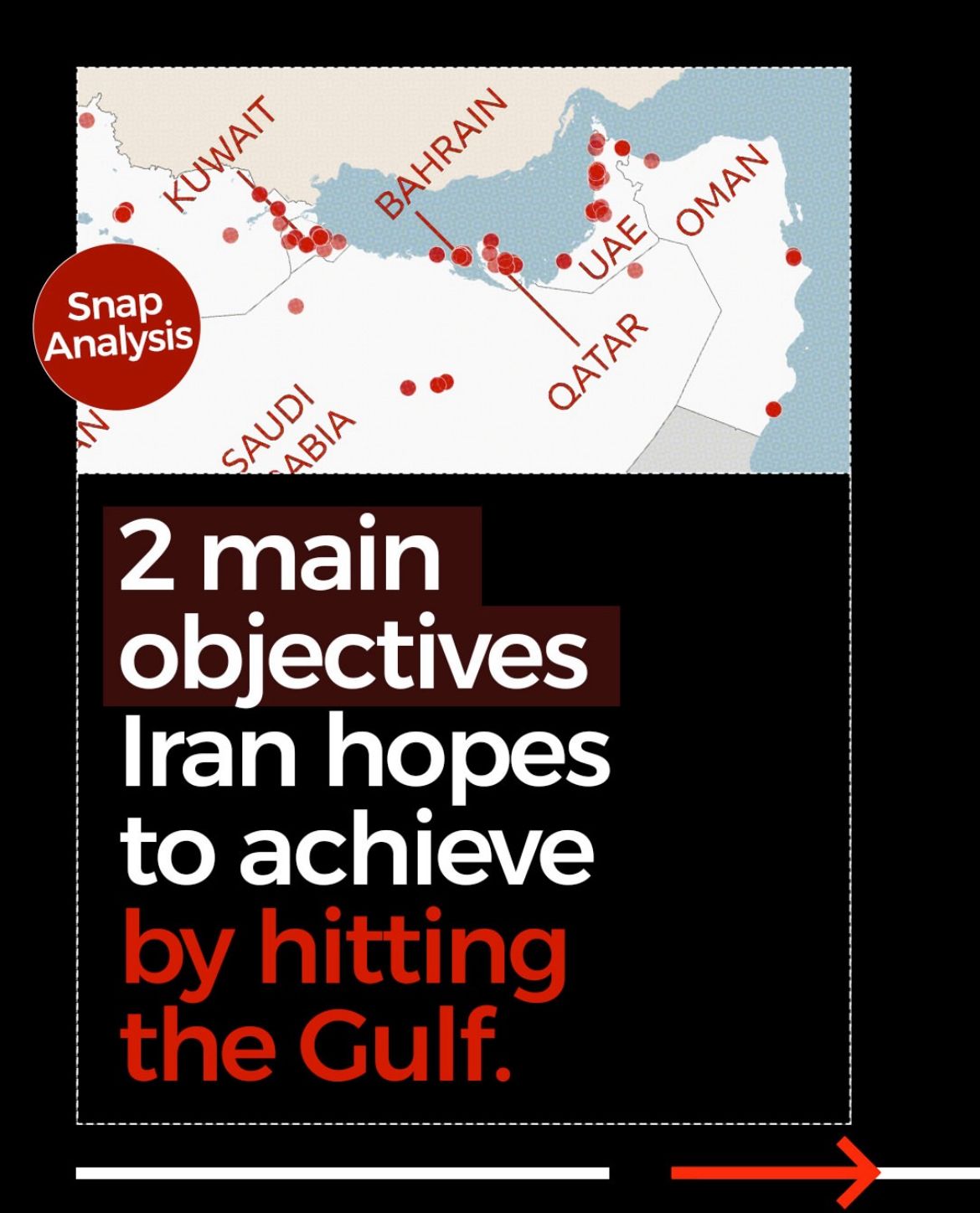

2 main objectives Iran hopes to achieve by hitting the gulf

20/03/2026
A
Since the U.S. and Israel launched their joint war on Iran on February 28, Iran has responded by attacking 11 countries, including Israel and American bases across the Middle East.
6 of those countries are the Gulf states of Saudi Arabia, the UAE, Oman, Qatar, Bahrain and Kuwait. This may seem like a predictable response at first. Iran had threatened to strike U.S. bases and interests across the region should the Americans initiate direct war with Iran.
But when the nature, volume and target list of the attacks are factored in, and the fact that the Gulf absorbed multiple times more attacks than Israel, Iran’s strategy becomes more confusing.
Didn’t Iran have enough enemies to deal with? By attacking energy sites, ports, and other exposed infrastructure across the Gulf and risking retribution, wasn’t Iran digging its own grave even deeper?
Perhaps, Iran’s strategy may seem even totally absent-as if the Islamic Republic was behaving as a dying regime seeking its final revenge. But that isn’t really the case.
Iran did not just fire at the Gulf. It hit multiple CCC states with large waves of ballistic missiles, drones, and some cruise missiles. The pattern matters more than any single strike: this was not random spillover. It was a deliberate way to move the costs of confrontation away from Iran and onto the Gulf, where the pressure would be felt faster and wider.
The first objective is short-term In the short term, Iran’s objective was to transfer pressure to the US and Israel without exhausting resources on their much more difficult targets.
The Gulf is simply more vulnerable terrain. It is full of exposed energy infrastructure, ports, desalination plants, and trade routes that can be disrupted with far fewer resources than it would take to seriously damage US targets or break Israeli defenses.
That is what makes places like the UAE so important in this strategy. The UAE is closely tied to both Washington and Israel, but it is also geographically exposed and economically plugged into global trade. So a strike there does more than create local damage. It sends pressure through markets, shipping, insurance, and allied politics all at once. The second is long term and the message is bigger.
Iran is signaling the baseline for future diplomacy in the Gulf: there is no real regional security without Iran at the table.
This fits the logic Iran previously followed on a micro scale, where calibrated insecurity is used not only to punish rivals but to reshape how they think about security itself.
Think of the Houthi-launched attacks on Saudi Aramco facilities that, 2 years later, brought Tehran and Riyadh closer, not further, under a Chinese-sponsored rapprochement.
Iran’s message to Saudi Arabia was simple and clear: working with us is better for your security than working against us.
The point Iran is aiming to make today is to weaken confidence in outside protection and push the region toward a more self-reliant security order that must include Iran rather than isolate it.
In other words, if the regime survives, it wants these attacks remembered not only as escalation, but as a reminder that any lasting Gulf stability will have to be negotiated with Tehran, not built around excluding it.
Of course, the risk of these objectives backfiring is there in Iran’s calculus-but facing Israeli and U.S. aggression, Iran
calculated that it has very little left to lose.